I help organisations decide what AI should do in their site search, write it down so it can be built or bought, and check that the answers hold up. Most of this work has been for New Zealand government websites, which millions of people rely on for accurate guidance.
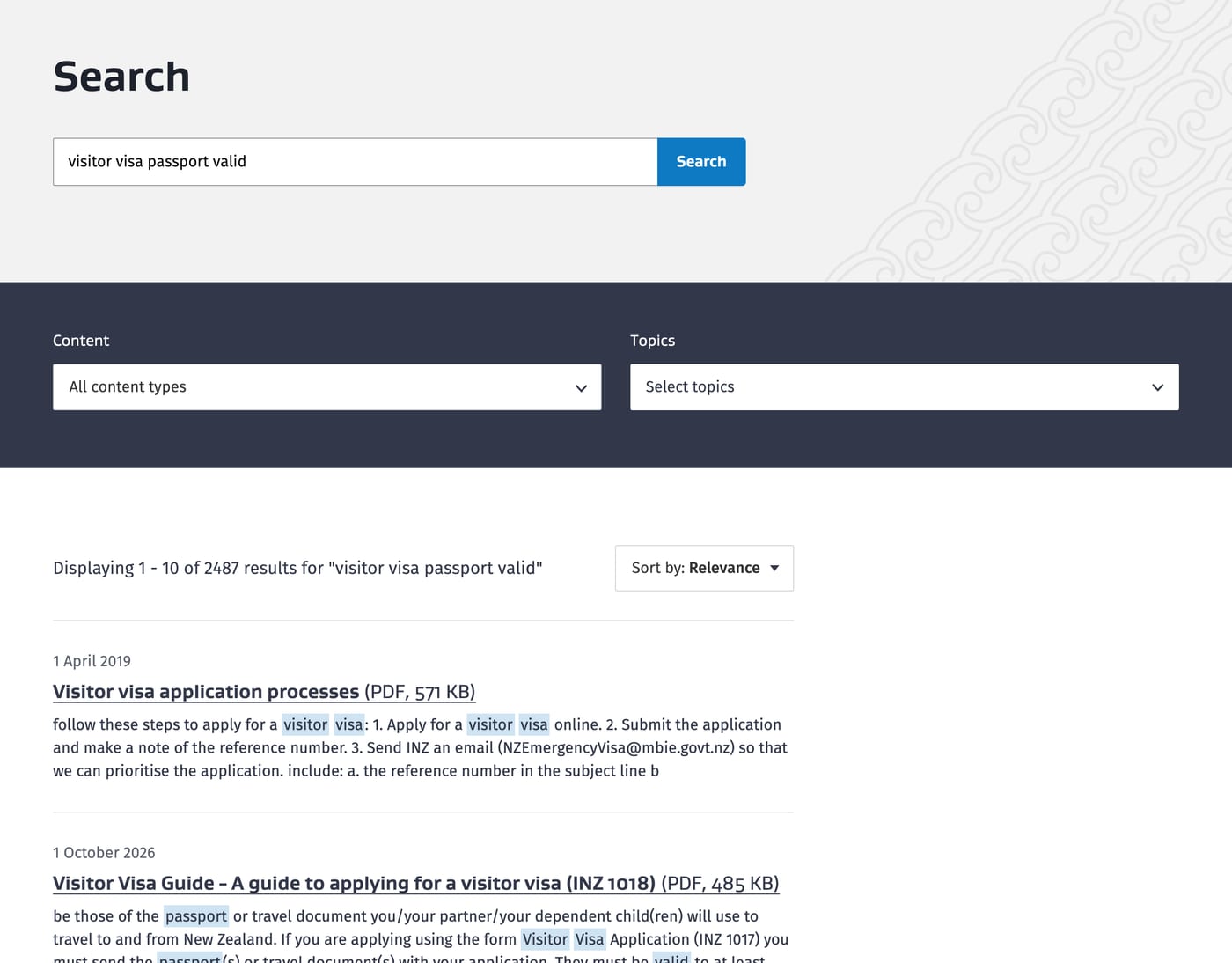
People now expect to ask a question in their own words and get an answer. Classic keyword search often hands them thousands of results instead. AI can close that gap, but "add AI to search" can mean very different things, with very different costs and risks.
Five ways to add AI to search
- Find. Matching on meaning as well as keywords, so "deposit" finds bond pages. No AI writing.
- Summarise. A short overview above the results, written from the top pages.
- Cite. A direct answer where every sentence links to its source, so it can be checked.
- Converse. Follow-up questions without starting again.
- Act. The conversation can work something out or open a form.
My AI search demo runs all five on the same question, so the differences are easy to see.
Where I've done it
- Developed a search roadmap and long-term recommendations for modern, AI-assisted search across MBIE's websites
- Worked on MBIE's search procurement: the research and options paper, and the functional requirements, including AI-assisted search
- Led a vendor-neutral evaluation of AI and enterprise search platforms, and reviewed how comparable platforms are used across the Australian and New Zealand public sector
- Briefed leadership and channel teams on the direction for AI-assisted search
Search roadmap · Findability at MBIE · Tenancy AI search demo
Common questions
What is AI search?
Site search that uses a language model somewhere in the process: to match on meaning as well as keywords, to summarise the top results, to write a direct answer that cites its sources, to hold a conversation, or to start a task. Each step adds value and risk, so it's worth choosing deliberately.
Should a government website add AI answers to its search?
Often, but not first. Better matching and a short summary of the top results help most people with little risk. Cited answers come next, once the content is accurate and well structured and the answers have been tested with real questions.
How do you choose an AI search platform?
Start from the questions people really ask and the content you have, then compare platforms on those, vendor-neutral. Test questions and evidence decide it, not demos.