People now ask ChatGPT, Copilot, Gemini and Google's AI Overviews before they visit a website. Generative engine optimisation (GEO) is about making sure those answers are accurate and point back to the source. For government guidance, a wrong answer can cost someone a visa, a bond or a benefit.
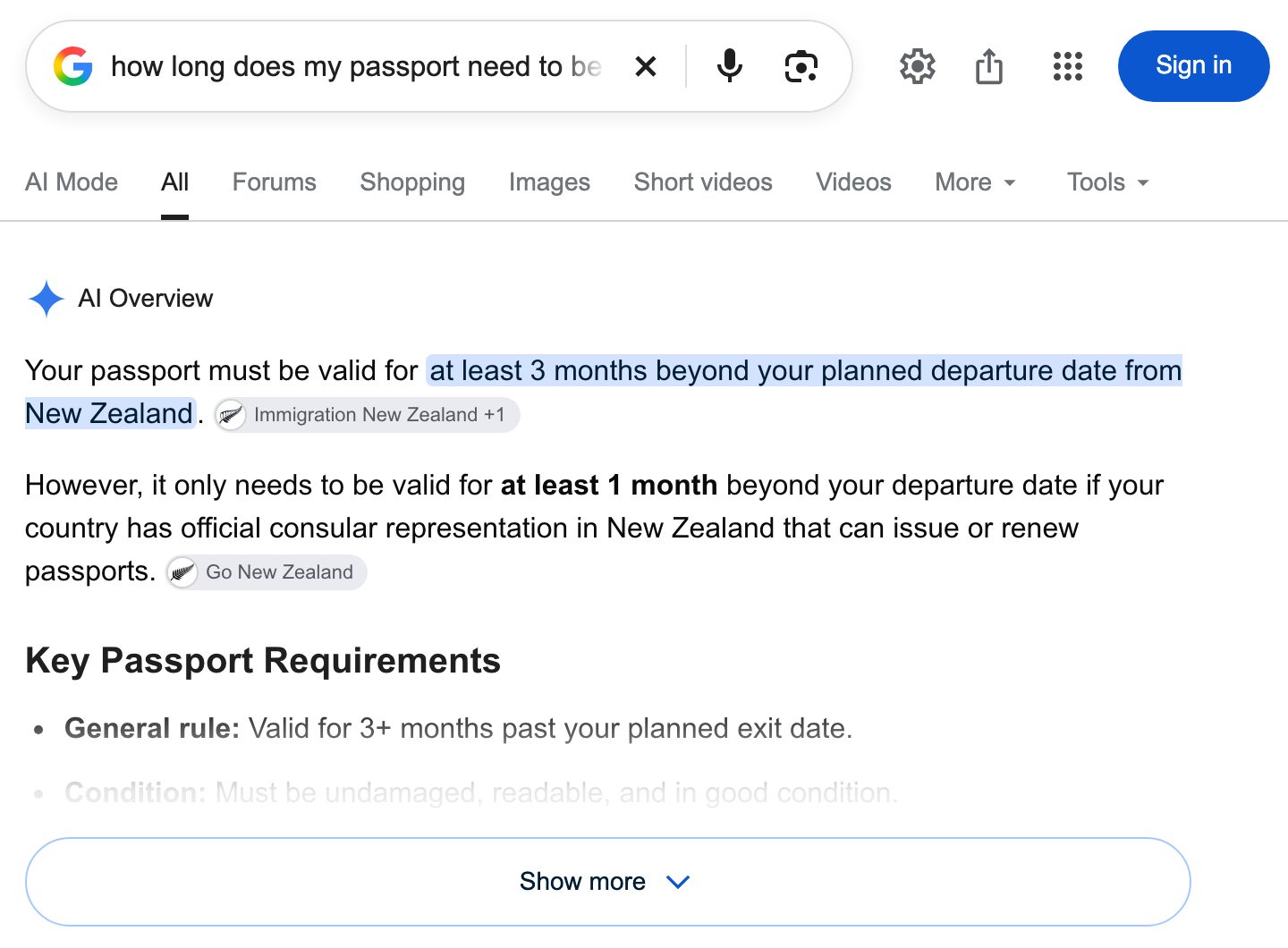
Measuring what AI says about you
I put 200 real immigration questions, taken from Immigration New Zealand's Search Console data, to Google, and checked all 2,008 facts in its AI Overviews against the official pages. 74% of the facts held up, but only 27 of the 200 answers were fully correct.
Most errors came from the official pages themselves: a condition written apart from the number it applies to, or the same figure published twice. That's good news, because it's something the content owner can fix.
What GEO work covers
- Checking how AI assistants describe an organisation's content, with real questions
- Fixing the content and structure behind wrong answers
- Assessing AI-visibility and AI-assisted audit tools
- Monitoring how content is cited over time
Where I've done it
- Developed MBIE's approach to GEO, including assessing AI-visibility and AI-assisted website audit tools
- Assessed how accurately Google AI Overviews represent government guidance, informing MBIE's direction on AI-assisted search
- Information architecture, taxonomy, metadata and SEO for info.health.nz, which kept health information findable while more than 200 older websites were retired
Findability at MBIE · info.health.nz
Common questions
What is generative engine optimisation (GEO)?
Making sure AI assistants and AI search results, such as ChatGPT, Copilot, Gemini and Google's AI Overviews, find an organisation's content, describe it accurately and link back to the source. SEO is about ranking in a list of links; GEO is about what the AI says.
How accurate are Google's AI Overviews?
In my check of 200 real immigration questions, 74% of the 2,008 facts in the AI Overviews held up against the official pages, and only 27 of the 200 answers had nothing wrong in them.
What causes AI answers to get government guidance wrong?
In that check, most errors came from the official pages themselves: a condition written apart from the number it applies to, or the same figure published twice. Fixing the content is often the best GEO.