I take AI features in websites and services, such as AI search, answer summaries and assistants, from an idea to something people use and trust. That means deciding what the feature should do, writing it down so it can be built or bought, testing the answers it gives, and fitting it into the content and interface around it.
I started out as a front-end developer and moved into UX and information architecture. So I follow how an AI feature is built as closely as what it should do, and I can work with developers, designers, content teams and leadership on the same feature.
What AI implementation covers
- Deciding what good looks like: what the feature should answer, what it shouldn't, and how you'll know it works
- Requirements: written so the feature can be built in-house or bought from a vendor
- Platform choice: vendor-neutral comparison of AI and search platforms
- Testing answers the way real people judge them, with real questions, not against a demo
- Content and structure the AI answers from, because that decides how good the answers can be
Where I've done it
At MBIE I wrote requirements for modern, AI-assisted search across MBIE's websites, and led a vendor-neutral evaluation of AI and enterprise search platforms, including Microsoft, Google and specialist providers.
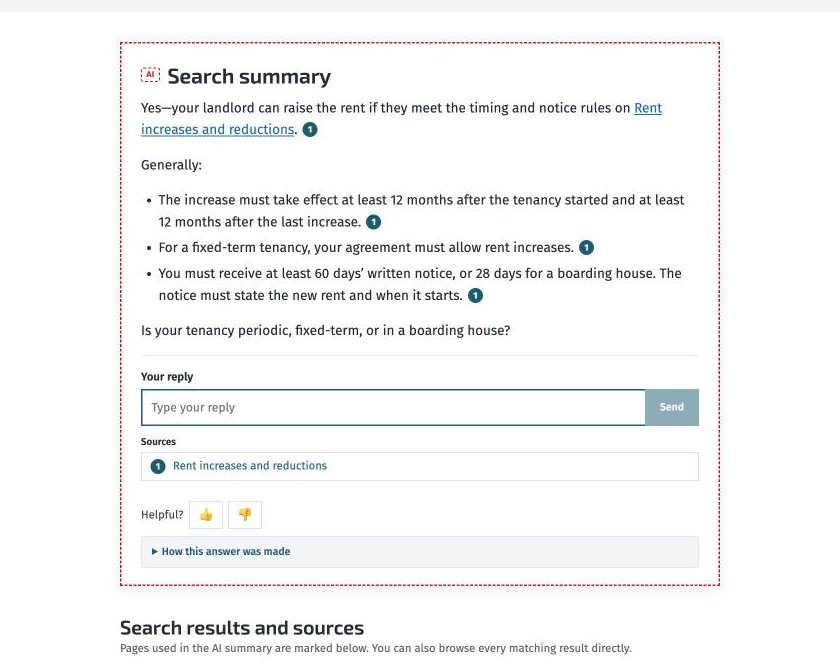
An AI search demo on tenancy.govt.nz content shows the different ways to build a language model into search, up to conversational search. It has a versioned system prompt, answer ratings and an evaluation script, and 13 guided tools where private details stay out of the AI chat. It's a demo, not an official service.
My own AI applications keep me close to what language models actually do with messy, real content, where they go wrong and what they cost to run. The Ask about Miro assistant on this site is one: it answers from my resume and projects, and links to its sources.
Tenancy AI search demo · Findability at MBIE
What I bring to a team working on AI
- A clear view of what a good answer looks like, so the team knows what it's building towards
- Content and information architecture that give AI something solid to work from
- Delivery within New Zealand's expectations on accessibility, privacy, te ao Māori and public trust
- Hands-on experience building with generative AI, and testing what it produces