Retrieval-augmented generation (RAG) is how most AI assistants and AI search answer from an organisation's own content: find the passages that match a question, then have a language model write an answer from those passages, citing each one. It's also behind internal knowledge tools that answer staff from policies and guidance.
On government content, RAG fails in predictable ways, and most of them are about the content rather than the model. I find those before launch, write the requirements that prevent them, and test the answers once it's running.
Why RAG fails on government content
- Stale pages. An old page that's still published, or still in the index, gets retrieved as readily as the current one.
- Duplicates. The same fee or rule on two pages, updated on one, so the answer depends on which copy is found.
- PDFs. Scanned forms, tables and old guidance that the system can't read well, or reads and treats as current.
- Conditions separated from numbers. "Dog registration costs $150." in one passage and "This fee applies to desexed dogs." in the next. The answer carries the number and loses the condition.
- Pages that arrive empty. Tools and finders that build their text with JavaScript can give the crawler almost nothing to read.
Questions I help answer
Content readiness
Before any content goes into a RAG system, I check it the way the system will read it, and give each problem a decision.
| Content | Problem | Effect on answers | Owner | Decision |
|---|---|---|---|---|
| Dog registration feesWeb page | Fee and its condition in separate sentences | Quotes the desexed fee to everyone | Animal services | Fix first |
| Rates due datesTwo pages | Published twice, one copy a year old | Gives either date | Rates | Fix first |
| 2019 building guidePDF | Replaced by a current page, still linked | Cites outdated consent rules | Building consents | Leave out |
| Bin day finderJavaScript tool | Text built in the browser | Nothing to retrieve | Digital | Link, don't index |
| Parking permitsWeb page | None found | Clear, dated, one copy | Transport | Ready |
DecisionsFix first: an edit before indexing. Leave out: excluded from the index. Link, don't index: answers point to the tool instead of quoting it.
Requirements, at the level that matters
I don't tune embeddings. I write down what the system must do with your content, so your team or vendor can build it and you can check they did:
- Chunking. Split on headings, keep a condition in the same passage as its number, and carry the page title and section into every passage.
- Metadata. Owner, last reviewed date, audience and content type on each passage, so the system can prefer current, official content and leave out the rest.
- Freshness. Re-index when a page is published or retired, not on a monthly schedule.
- Citations. Every point linked to the page it came from, with the page's date, so a person can check it.
- Declining. What it should say when the content doesn't cover a question, and when it should hand over to a person.
Choosing a platform
Many platforms offer RAG, including the AI features of tools an agency already licenses. I compare them on your own content with the same real questions, scored without knowing which platform answered, and on what they let you control: sources, exclusions, freshness, logs, privacy and cost at real volume. More in how to choose an AI platform without trusting the demo.
Where I've done it
- At MBIE, wrote requirements for modern, AI-assisted search across MBIE's websites and was part of a team that compared AI and enterprise search platforms
- At MBIE, checked Google's AI Overviews against official pages: the way pages were written, for example a condition sitting apart from its number, contributed to wrong answers
- At Health New Zealand, shaped the information architecture, taxonomy and metadata for info.health.nz, which brought more than 200 older health websites into one
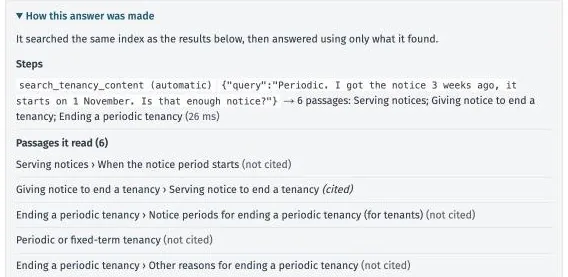
- My tenancy AI search demo: public pages copied and split into passages, keyword and meaning search combined, and Claude told to answer only from the passages it found. It can't read the site's PDFs, which is a lesson in itself
Findability and AI search at MBIE · info.health.nz
Common questions
What is retrieval-augmented generation (RAG)?
RAG is how most AI assistants and AI search answer from an organisation's own content. The system searches the content for the passages that match a question, then a language model writes an answer from those passages only, citing each one. The answer can only be as good as the passages it finds.
Why does RAG give wrong answers on government content?
Usually because of the content, not the model: out-of-date pages that are still indexed, the same fact on two pages that have drifted apart, PDFs the system can't read, and conditions that sit apart from the numbers they apply to, so a passage carries the number without the condition.
Should we fix our content before adding RAG?
Check it first. A content readiness check finds the pages that would give wrong answers, and the fixes are usually small edits, retiring old pages or leaving some content out. Then test the answers with real questions before launch.