Ask Google a government question and the first thing you often read is an AI Overview. Generative engine optimisation (GEO) is the work of making Google, ChatGPT, Claude, Copilot and Gemini quote an organisation correctly and point back to the source. For government, the goal is being quoted correctly, not being recommended: a wrong answer can cost someone a visa or a bond.
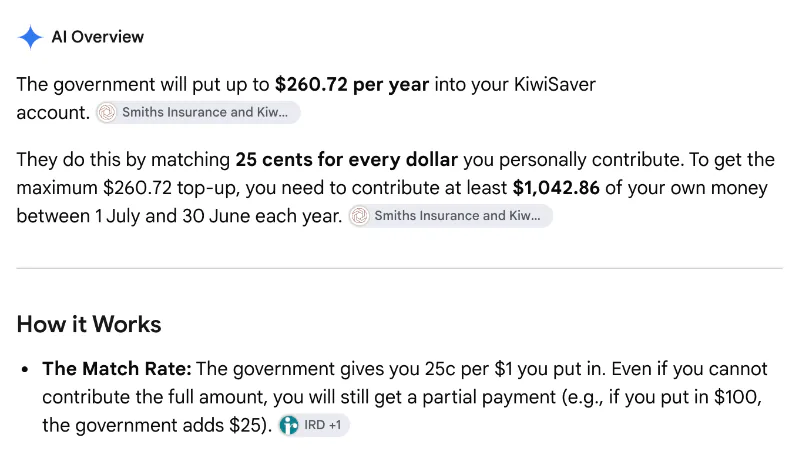
Nobody controls what these tools say. What an organisation controls is what they read: its content, whether crawlers can reach it, and how clearly each page states its facts. That's where I work.
What affects how AI tools quote you
- Content. AI tools lift single sentences. A fee and its condition in the same sentence survive; a fee in one sentence and "this applies to desexed dogs" in the next often don't. Dates on anything that changes, and each fact published once, matter as much.
- Crawlers. AI companies run separate crawlers for training, for AI search and for fetching a page when someone asks. Blocking the wrong one takes your pages out of AI answers. Allowing them doesn't guarantee being cited, but blocking rules it out. See should government websites block AI crawlers?
- Pages that arrive empty. A page that builds its text with JavaScript can look blank to an AI tool. See pages that are blank to AI.
- Structured data. Clear titles, metadata and schema.org markup help a tool work out what a page is and who published it. They don't make a vague page accurate.
- Other sites. Old copies and third-party pages repeating last year's figure. The fix is often retiring your own outdated pages, so the current one is what gets found.
Measuring what AI says about you
At MBIE, I put real immigration questions to Google and checked the facts in its AI Overviews against the official pages. A missing condition here or there was enough to make an answer misleading.
In the answers I checked, the way the official pages were written contributed to the errors: a condition written apart from the number it applies to, or the same figure published twice. That's the part a content owner can fix. Retrieval, out-of-date copies and the model itself play a part too.
Accuracy and visibility are separate questions. An answer can cite your page and still get it wrong, or be right without citing you, so I track them separately.
Checking AI Overviews for accuracy · Why AI gets your agency wrong
Questions I help answer
What GEO work covers
- Checking how AI assistants describe an organisation's content, with real questions
- Fixing the content and structure behind wrong answers
- Deciding crawler access on purpose, and making the firewall match robots.txt
- Assessing AI-visibility and AI-assisted audit tools
- Monitoring how content is cited over time
Where I've done it
- Worked on MBIE's approach to GEO, including assessing AI-visibility and AI-assisted website audit tools
- Assessed how accurately Google AI Overviews represent government guidance
- Information architecture, metadata and SEO for info.health.nz, which kept health information findable while more than 200 older websites were retired
- This site: llms.txt, Markdown copies of every page, an MCP server, and a log of which AI crawlers read which pages
Findability and AI search at MBIE · info.health.nz
Further reading: Is this SEO or GEO? on Foundable.
Common questions
What is generative engine optimisation (GEO)?
Generative engine optimisation (generative engine optimization in US spelling) is improving the chances that AI assistants and AI search results, such as ChatGPT, Claude, Copilot, Gemini, Perplexity and Google's AI Overviews, find an organisation's content, describe it accurately and link back to the source. Nobody controls what these tools say; GEO works on the pages they draw on and checks the results. Where SEO is about ranking in a list of links, GEO is about what the AI says.
How accurate are Google's AI Overviews?
It varies by question and changes over time, so it has to be checked. When I checked them on real immigration questions at MBIE, the lesson was that an answer only needs one missing condition to mislead.
What causes AI answers to get government guidance wrong?
Several things: which pages the tool retrieves, how current they are, how the model reads them, and other sites repeating old figures. In the answers I checked, the way official pages were written played a big part: a condition written apart from the number it applies to, or the same figure published twice. That part the content owner can fix.
Do you work with organisations in Auckland and the rest of New Zealand?
Yes. I'm based in Wellington and work with agencies, councils and other organisations across New Zealand, including Auckland, on-site, hybrid or remote.