Often because of how official pages are written, rather than the AI making things up. AI tools lift facts from your pages, and the facts that go wrong tend to be the ones that are easy to misread: a number in one sentence and its condition in the next, the same figure on two pages, a fee with no date. That part is yours to fix.
What checking the answers shows
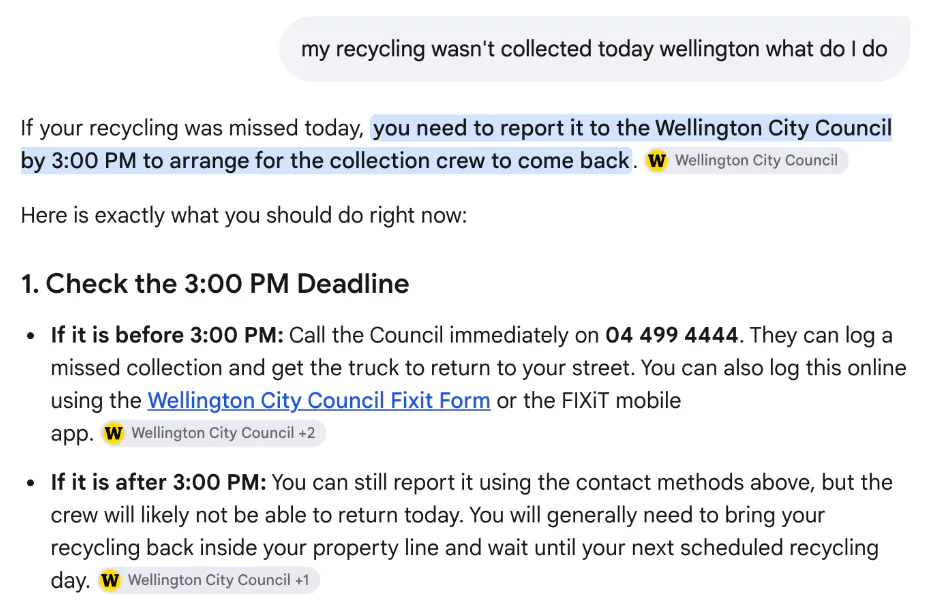
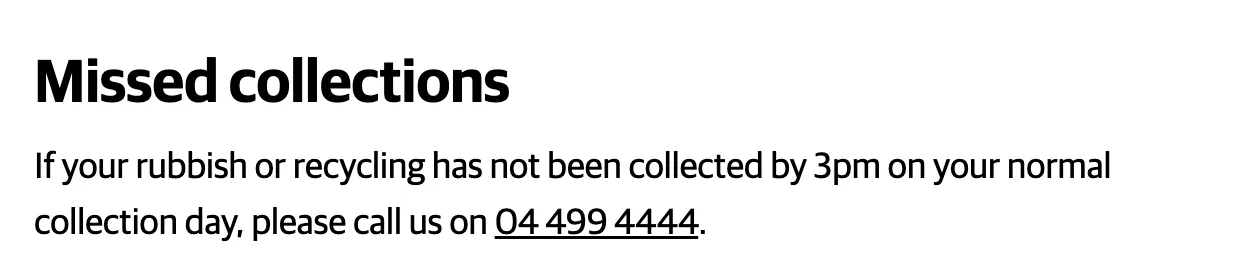
Take the questions people actually ask an agency, typed the way they type them, and check Google's AI Overviews fact by fact against the agency's own pages. The method is simple: split each answer into its separate facts, and check each one against the official page.
An answer can be mostly right and still mislead. A reader can't tell which of several facts is the wrong one, so the whole answer is what counts. And a wrong answer usually still links to the agency, so it looks official whether or not it matches what the site says.
Three patterns behind wrong answers
In the answers I've checked, Google wasn't inventing much. Where an answer went wrong, the official page was often correct but easy to misread. These three patterns came up again and again.
The condition sits apart from the number. Take a made-up council page: "Dog registration costs $150. This fee applies to desexed dogs." Both sentences are true. When an AI tool reads them one at a time, as it often does, the answer becomes "the fee is $150", which is wrong for most dog owners. The number travels; the condition stays behind.
Number and condition together
Registering a desexed dog costs $150. For a dog that isn't desexed, it's $230.
Each sentence is still true when it's read on its own.
Condition in the next sentence
Dog registration costs $150. This fee applies to desexed dogs.
Lifted alone, the first sentence says every dog costs $150.
The same fact is published twice. When a figure appears on two pages, the copies drift apart over time, and an AI tool may pick up either one. It has no way of knowing which page your team updated last.
Things that change have no date. Fees, processing times and thresholds change. Without a date on the page, nothing tells an AI tool, or a person, whether the figure is current. Copies of your page on other sites can keep an old figure alive long after you've changed it.
One page, with a date
From 1 July 2026, registering a desexed dog costs $150.
Other pages link here instead of repeating the figure, and anyone can see it's current.
Two copies, no date
Fees page: $150. Dog owners' guide: $145.
Neither says when it applies, so an AI tool may quote either.
Why it's harder to see than a broken page
When someone reads an AI answer and doesn't click through, your analytics can't show what they read. They act on it without visiting your site, so the usual measures can't tell you what the public is being told.
Causes that aren't on your pages
Not every wrong answer starts with your content. The tool may retrieve an older page, a cached copy or a third-party site that repeats an out-of-date figure. Its index may be weeks behind your last update. And the model can misread a page that's perfectly clear. Checking the cited source for each wrong answer tells you which kind you're dealing with, and whether a content fix will help.
The answers also move. The same question can get a different answer, from a different source, on a different day, so a single check isn't enough.
And the cost lands on people and on your front line. In immigration, a wrong answer can mean a refused boarding, a missed deadline or a fee paid for an application that can't be accepted. In most services it means a phone call, a complaint or a correction your team has to make.
What you can do about it
- Check what AI tools say, with real questions. Take the questions people actually search, from your Search Console data, put them to Google, ChatGPT and Claude, and check each fact against your pages.
- Keep the condition in the same sentence as the number. "Registration costs $150 for a desexed dog" survives being quoted; the fee in one sentence and the condition in the next doesn't.
- Put a date on anything that changes. Fees and wait times change, and a date tells people and AI tools whether the figure is current.
- Publish each fact once and link to it. Copies on different pages drift apart over time.
- Retire the pages nobody owns. In 2026 the UK Department for Business and Trade found a Google AI Overview quoting old Companies House fees from a page nobody maintained. It reviewed old, little-read pages with no owner, retired about 150 of them, and now shows when each page was last reviewed and when it's due again (how DBT did it).
- Make sure AI search tools can read your site. If their crawlers are blocked by accident, they answer from other people's copies of your content. See should government websites block AI crawlers?
- Check again regularly. The answers change from day to day.
None of this needs new technology. It's content design: writing facts so they survive being quoted out of context, by a person or by a machine.
Where to start
Pick the ten questions your contact centre hears most, ask them the way people ask them, and read what comes back. If the answers are wrong, look at the page they cite, and you'll usually find one of the three patterns above.
If you'd like this done properly across a whole site, the findability audit includes an answer-accuracy check, using the method I used at MBIE. I also work alongside teams on findability, AI search and AI implementation: see AI project consulting.