Ask Google an immigration question and the first thing you often read is an AI Overview. Generative engine optimisation (GEO) is about checking what Google, ChatGPT, Claude, Copilot and Gemini say, and improving the pages they draw on so their answers are more likely to be accurate and point back to the source. For government guidance, a wrong answer can cost someone a visa or a bond.
Measuring what AI says about you
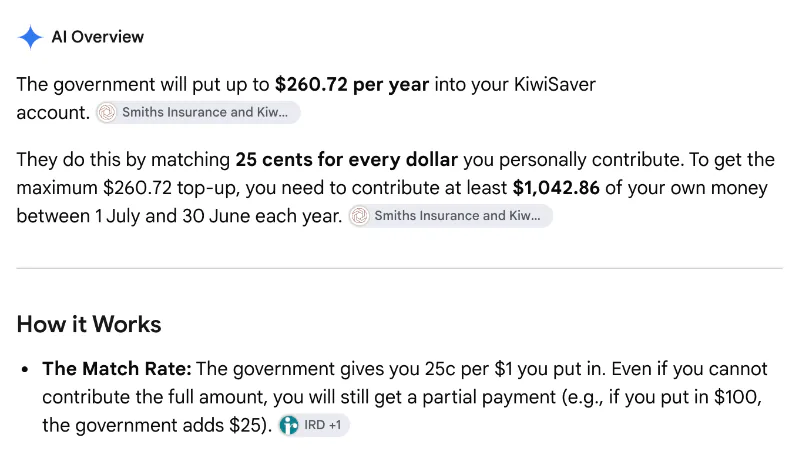
At MBIE, I put real immigration questions to Google and checked the facts in its AI Overviews against the official pages. A missing condition here or there was enough to make an answer misleading.
In the answers I checked, the way the official pages were written contributed to the errors: a condition written apart from the number it applies to, or the same figure published twice. That's the part a content owner can fix. Retrieval, out-of-date copies and the model itself play a part too.
Accuracy and visibility are separate questions. An answer can cite your page and still get it wrong, or be right without citing you, so I track them separately.
Checking AI Overviews for accuracy
Questions I help answer
What GEO work covers
- Checking how AI assistants describe an organisation's content, with real questions
- Fixing the content and structure behind wrong answers
- Assessing AI-visibility and AI-assisted audit tools
- Monitoring how content is cited over time
Where I've done it
- Worked on MBIE's approach to GEO, including assessing AI-visibility and AI-assisted website audit tools
- Assessed how accurately Google AI Overviews represent government guidance
- Information architecture, metadata and SEO for info.health.nz, which kept health information findable while more than 200 older websites were retired
Findability and AI search at MBIE · info.health.nz
Want to know what AI tools say about your agency? Ask Google, ChatGPT and Claude a few questions people ask you, and compare the answers with your pages. The findability audit works out why an answer is wrong, and what to fix.
Common questions
What is generative engine optimisation (GEO)?
Improving the chances that AI assistants and AI search results, such as ChatGPT, Claude, Copilot, Gemini, Perplexity and Google's AI Overviews, find an organisation's content, describe it accurately and link back to the source. Nobody controls what these tools say; GEO works on the pages they draw on and checks the results. Where SEO is about ranking in a list of links, GEO is about what the AI says.
How accurate are Google's AI Overviews?
It varies by question and changes over time, so it has to be checked. When I checked them on real immigration questions at MBIE, the lesson was that an answer only needs one missing condition to mislead.
What causes AI answers to get government guidance wrong?
Several things: which pages the tool retrieves, how current they are, how the model reads them, and other sites repeating old figures. In the answers I checked, the way official pages were written played a big part: a condition written apart from the number it applies to, or the same figure published twice. That part the content owner can fix.